
How to Prevent a Wedgie: Keeping your Costume in Place
This post may contain affiliate links, if you purchase through these links, I earn a small commission at no additional cost to you.

A dance costume should help a dancer feel bright, strong, and ready. It should not make them worry, “Will this strap fall down?” or “Is my skirt moving?”
The good news is that a little prep can help a lot. You do not need to pull, pinch, or hope for the best. You can check the fit, make a small costume kit, and use the right kind of tape or body adhesive for the job. Here is a simple guide for keeping costumes where they belong—on stage, in class, and at competition.
Start With a Good Fit
The best way to keep a costume in place is to start with a costume that fits well.
Try the costume on before dance day. Do not only stand in front of a mirror. Do a few safe dance moves, too. Reach up. Bend down. Twist. Do a small jump. Sit down. Lift your arms like you do in your dance.
Ask these questions:
• Does the top stay up?
• Do straps stay on the shoulders?
• Does the leotard stay smooth?
• Does the skirt stay in the right spot?
• Can the dancer breathe and move?
If a costume is too big, tape may not fix the whole problem. A loose strap may need to be sewn shorter. A loose seam may need a few stitches. A missing gem or loose piece of trim needs a costume repair, not body tape. Check the costume from the front, back, and sides. Take a quick photo or video while the dancer moves. This can show a slipping strap or a gaping neckline that is hard to see in a mirror.
Make a Small Costume Kit
A small kit can save the day. Keep it in the dance bag. Put the items in a clean zip bag or little box.
Your kit should have:
• Safety pins
• A small sewing kit
• Extra clear elastic, if the costume uses it
• A few kinds of tape
• A body adhesive, if your family chooses to use one
• Scissors
It is smart to have a few choices. One item may work well for a strap. Another may work better for a neckline. But do not put every product on every part of a costume.
Clean and Dry Helps Things Stick
Most body tape and skin adhesives need clean, dry skin. Lotion, body oil, sweat, and sunscreen can make tape slide off. Wipe the area with a clean cloth if needed and let it fully dry.
When applying, try not to touch the sticky of a tape part too much. Fingers can leave oil behind. That may make the tape less sticky.
Also check the costume fabric. Some fabrics are soft and strong. Some are very delicate. A costume may have glue-backed trim, beads, rhinestones, or gems. Tape can pull on these parts. Never assume a product is safe for every costume. Test first.
Do a Practice Test Before Show Day
Do not try a new tape or glue for the first time five minutes before the music starts.
A few days before the event, do a small practice test. First, test a tiny spot of skin. Then test a hidden spot of the costume fabric. These are two different tests. A product can feel okay on skin but still hurt the fabric. Or it can be fine on fabric but bother the skin.
A quick test is helpful, but it is not a promise. Some skin reactions can show up later. Check for itching, burning, pain, or redness. If skin feels bad, gently remove the product and do not use it again. That is why it is smart to test early and pay attention to how the skin feels. Do not use tape or glue on broken, sore, or irritated skin.
Use the Right Tool for the Right Problem
Think about what is moving before you grab tape or glue.
A neckline is opening: Try a small piece of body-and-clothing tape after a practice test.
A costume edge is rolling or riding up: A small amount of a dance body adhesive, such as Suffolk Butt Glue, may help if the label and your test say it is okay.
A shoulder strap is too long: Sew it, have it altered, or ask the costume maker for help. Tape may only be a short-term helper.
A seam is coming apart: Use a needle and thread, or get a repair. Skin tape will not repair a seam.
A gem, bead, or trim piece is loose: Do not cover it with tape and hope. Ask a grown-up to use a repair method that is right for that costume.
The costume is too big everywhere: It may need to be altered. A costume should feel snug but not so tight that it hurts or makes breathing hard.
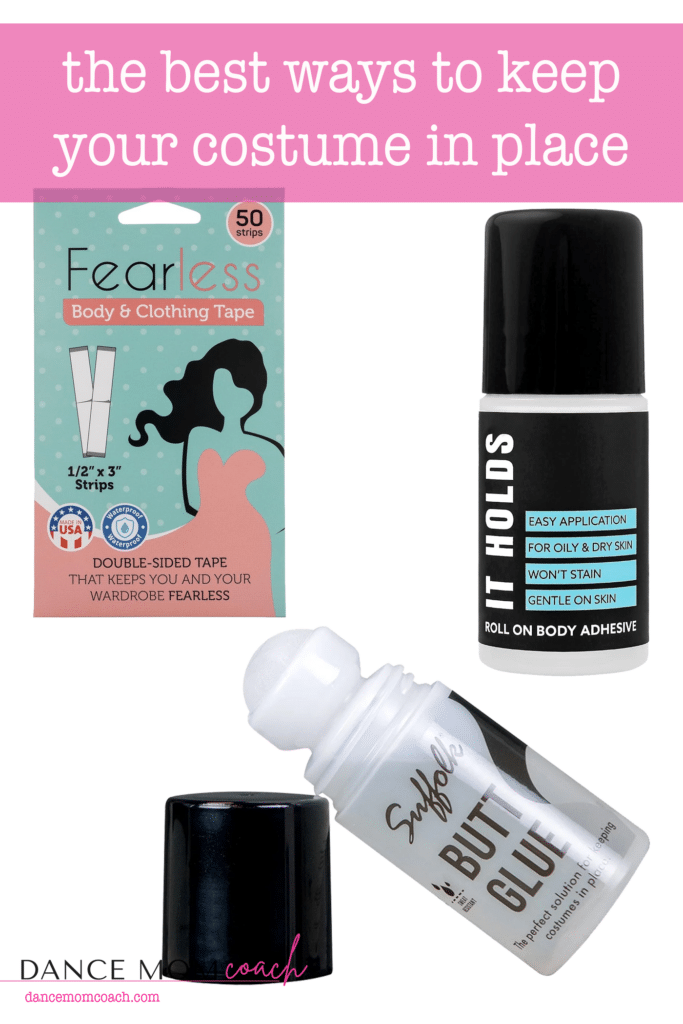
Butt Glue
Butt Glue/Costume Adhesive is a roll-on body adhesive. They are made to help hold dancewear or a costume edge against the skin. The name may sound silly, but the job is simple. It can help when a leotard leg line, costume bottom, or other fabric edge wants to ride up or move around.
Butt glue is easy to use. Roll the product on to dry skin, wait until it feels a little tacky, and then press the costume into place. Butt glue will keep your skin sticky for hours afterwards, if you have a costume change I recommend wiping it off with a damp cloth or baby wipe.
Product Picks: Suffolk Butt Glue, It Holds Roll on Body Adhesive, It Stays! Butt Glue
Product Pick: Body-and-Clothing Tape
Body-and-clothing tape is also called fashion tape or clothing tape. It is usually double-sided. One sticky side touches skin or cloth. The other side holds the costume edge in place. This kind of tape can be useful for a neckline that opens when a dancer bends, a strap that will not lie flat, or a small piece of fabric that needs to stay close to the body.
One example is Shanthi Tailors Double-Sided Fashion Body Tape. The seller says to use it on clean, dry skin, test an unseen part of the fabric first, and peel it off gently. The seller also describes it as single-use tape.
A second example is Fearless Tape, a fashion-tape brand that also tells users to start with clean, dry skin and fabric and to test fabric before using more tape.
For any body-and-clothing tape, cut small pieces. A huge strip can be hard to remove and may pull on a costume. Place the tape only where you need it. Press the costume down gently. Then move around for a minute to make sure it still feels good.
When it is time to take the costume off, go slow. Peel the tape gently. Do not yank. If a product gives special removal steps, use those steps.
Product Pick: Fearless Clothing & Body Tape
What About Other Tapes?
Ask about butt glue around seasoned dance moms and you’re likely to get a list of alternatives including many kinds of tape. Some of those tapes were not formulated for use on a human body, so use with caution! Skin reactions to the adhesive or damage to delicate costumes may be the result. Be extra careful around mesh, lace, glitter cloth, glued trim, beads, and rhinestones. Very sticky tape may pull threads, leave residue, or lift a decoration.
Toupee tape is a kind of tape made to help hold a hairpiece in place. Some dance families may already have it at home. It can be very sticky, but it is a hairpiece product. It is not automatically the same thing as body-and-clothing tape, and it may damage the costume.
Carpet tape is frequently mentioned as an option for keeping a costume in place. The adhesive in carpet tape is formulated for use with very different materials than skin and costumes! I would proceed with great caution if you decide to go this route, with tests on both skin and the costume material before use.
Keep Comfort First
A costume should stay put, but the dancer should still feel comfortable. Never tape so tightly that it hurts. Never use tape to hold skin together. Never put it over a cut, rash, or sore spot. Do not use a product that burns, itches, or feels wrong.
If a dancer has strong pain, swelling, blisters, or a skin reaction that does not get better, stop using the product and talk with a health professional.
Disclosure: This post contains affiliate links. If you purchase through these links, I earn a small commission at no additional cost to you. As an Amazon Associate, I earn from qualifying purchases.